Asset Diversification: Asset Classes, the U.S. Dollar, and International Markets

By Thibaut Guéant, co-founder and CIO of LandQuireUpdated on 12-minute read
Table of Contents
- What is asset diversification?
- Why is the French population's wealth so undiversified?
- What are the four key areas of asset diversification?
- Which asset classes should you combine?
- Why take on international exposure and exposure to the dollar?
- What role do real assets and U.S. real estate play?
- How should you allocate your assets based on their total value?
- What mistakes should you avoid in your diversification strategies?
- Frequently Asked Questions

Asset diversification involves spreading your savings across investment vehicles that do not react in the same way to crises.
In France, it remains limited: according to INSEE, real estate accounts for 61% of households’ gross wealth, almost always in a single currency and a single country.
This guide explains why to diversify, in which areas, and what role to assign to the dollar, foreign markets, and real assets such as U.S. real estate.
In a nutshell
- Real estate accounts for 61% of French households’ gross wealth, ahead of financial assets (22%) and business assets (11%) (INSEE, early 2024).
- For households with assets ranging from €112,100 to €857,700, real estate accounts for about 70% of their total assets, rising to 75% at the midpoint of the distribution (INSEE, December 2025).
- Only 17.4% of households hold securities, such as stocks or bonds (INSEE, May 2025).
- The dollar accounts for 56.70% of global foreign exchange reserves, compared with 20.60% for the euro (IMF, second quarter of 2026).
- Inflation reached 3.1% year-over-year in September 2026: savings that yield lower returns lose purchasing power (INSEE).
- Interest, dividends, and capital gains are subject to a single flat-rate withholding tax of 31.4% in 2026, of which 18.6% consists of social security contributions (service-public.fr).
What is asset diversification?
Diversifying your portfolio means spreading your capital across several investments whose risks are uncorrelated: a setback in one area does not affect the rest.
The goal is not to avoid all losses, but to limit exposure to the specific risks associated with a single sector, currency, or country.
Diversification, dispersion, and allocation: three distinct concepts
Diversification spreads the overall risk of the portfolio across genuinely different asset classes: stocks, bonds, real estate, cash, and real assets.
This fragmentation results in multiple policies with no overall strategy. Three life insurance policies invested in the same funds provide no protection—only higher fees.
Asset allocation is the distribution of your investments, determined in advance based on your goals, investment horizon, liquidity needs, and investor profile.
A good diversification strategy starts with asset allocation: you determine the role of each portfolio segment, and then select the investments.
Why is the French population's wealth so undiversified?
As of early 2024, the average household held €374,900 in gross wealth, accordingto an INSEE study on wealth levels in 2024.
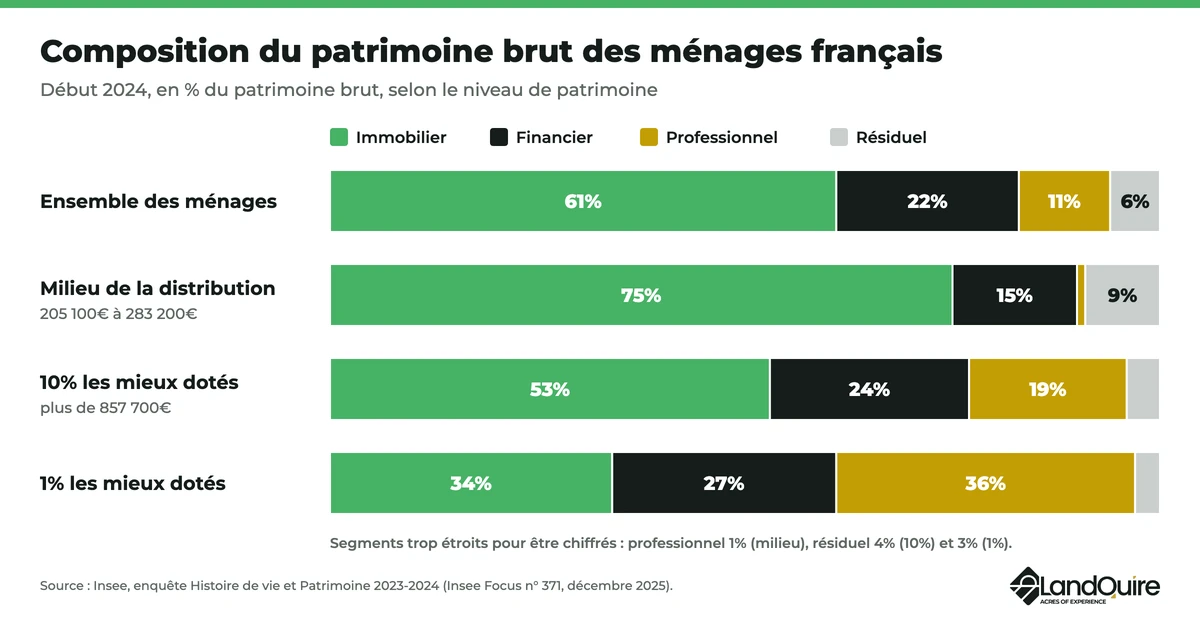
This wealth consists of 61% real estate, 22% savings and securities, 11% business assets, and 6% miscellaneous assets (cars, equipment).
For half of all households—those in the 4th through 9th deciles—real estate accounts for about 70% of their total assets, and nine out of ten own their primary residence.
Its share declines only among the wealthiest: 53% for the top 10% and 34% for the top 1%, whose assets are much more diverse.
In terms of investments,the INSEE study on asset holdings in 2024 shows that 90.5% of households hold at least one financial product.
But these are primarily regulated savings accounts and insurance policies: only 17.4% hold securities, and 9.6% have a securities account.
The result: a typical French fortune depends on real estate, a single currency, and a single tax system.
It's a concentration, even when the amount is high.
What are the four key areas of asset diversification?
Effective diversification strategies—whether for institutional investors or high-net-worth individuals—combine four key elements.
Each one reduces a different risk; none is sufficient on its own.
| Axis | Reduced risk | Examples | Point to Watch For |
|---|---|---|---|
| Asset Classes | A shock in a market (stock market, real estate, interest rates) | Cash, bonds, stocks, real estate investment trusts (SCPI), real assets | The selected media must react differently |
| Geographic Areas | Dependence on the French and European economies | Global ETFs, real estate, or overseas housing | Local Taxation and Tax Treaties |
| Currency | Dependence on the euro | Balances in dollars, Swiss francs, and pounds | Exchange rates fluctuate in both directions |
| Liquidity and Time Horizon | Needing money at the wrong time | Available savings, 3-8-year portfolio, long-term portfolio | An illiquid asset ties up money for several years |
Sources: INSEE (2024–2025), IMF (2026).
A tax allowance is not a form of diversification
Life insurance, PEA, PER, and brokerage accounts are vehicles: their tax treatment matters, but the tax exposure depends on what they hold.
A multi-asset contract can include a guaranteed fund, unit-linked products, ETFs, or real estate investment trusts; therefore, two contracts can be very different or nearly identical.
The PEA continues to focus on European companies. To gain direct access to U.S. markets, you need a securities account or assets held outside these investment vehicles.
Which asset classes should you combine?
Each asset class serves a specific purpose in a wealth management strategy: to protect, to grow, to generate income, or to provide diversification.
No single investment offers a combination of return, safety, and liquidity—which is why we combine them.
- Liquid assets (regulated savings accounts, guaranteed funds, money market funds) serve as a reserve. The Livret A yields 1.7%, according to the official information on service-public.fr.
- Bonds provide a more consistent return, but their value falls when interest rates rise, and the issuer may default.
- Stocks are the long-term driver of a portfolio, but they are highly volatile: plan for an investment horizon of 8 years or more.
- Real estate (residential, rental properties, SCPIs, and publicly traded real estate investment trusts) generates rental income, but it is already the dominant asset class in most French fortunes.
- Alternative assets (private equity, commodities, gold, real estate) aim to achieve partial decorrelation from the stock market, at the cost of the risk of capital loss and low liquidity.
With year-over-year inflation at 3.1% in September 2026, according toINSEE’s Consumer Price Index, the safety net is losing purchasing power.
Recent returns for each investment and examples of asset allocation by profile are included in our guide to investing.
Unlisted investments are covered in our section onalternative investments.
Why take on international exposure and exposure to the dollar?
A fortune denominated in the single currency depends on European growth, ECB policy, and national fiscal decisions.
Geographic diversification opens up new economic cycles and opportunities: demographics, sectors with limited presence in European markets, and returns spread out over time.
The dollar remains the world's leading currency. According to the IMF's report on the composition of foreign exchange reserves, its share stood at 56.70% in the second quarter of 2026.
The euro's return was 20.60% over the same period. Holding a portion of one's capital in dollars means gaining exposure to the currency that dominates central bank reserves.
Foreign Exchange: Diversification in Both Directions
A dollar-denominated asset gains value when converted if the dollar rises, and loses value if it falls, regardless of the asset's own performance.
This exposure is managed based on the size of the portfolio and the time horizon: it has less of an impact on a minority stake held for several years.
Our guide to investing in dollars explains how to open a USD account and transfer funds.
Ways to Enter the United States
- U.S. stocks and ETFs held in a securities account: liquid, but volatile.
- U.S. Publicly Traded Real Estate Investment Trusts( REITs ): Leased Properties, Priced by the Stock Market.
- Real estate or land held directly or through a corporation: a tangible, illiquid asset subject to U.S. tax.
For an investor who is a resident of France, income and capital gains from U.S. sources are governed by the France-U.S. tax treaty, which prevents double taxation.
What role do real assets and U.S. real estate play?
Real assets are tangible assets: real estate, land, infrastructure, and raw materials. Their value does not depend on daily stock market prices.
In the United States, farmland is expected to be worth an average of $4,500 per acre in 2026, up 3.4% from a year earlier, according to the USDA’s Land Values report.
For French investors, one of the advantages of U.S. real estate is that it combines three factors: a tangible asset, a different geographic region, and a different currency.
The LandQuire Model
LandQuire, founded in 2021 by Romain Daniellou and Thibaut Guéant, purchases land on the outskirts of growing U.S. cities.
It obtains the necessary permits (zoning, subdivision, and utility access), then resells the land to developers.
The profit comes from appreciation, not from rent: there is no rental management involved.
The team analyzes all 3,143 U.S. counties using an algorithm based on more than 120 criteria. LandQuire has completed 50 transactions, 37 of which have been sold: see our sold real estate projects.
Each property is managed by a dedicated project company, overseen from start to finish by LandQuire. The fee is $100,000, which is included in the project budget.
The company plans to operate for approximately 36 months, with no guarantees (expect 5 years or more). An independent CPA handles U.S. tax matters, and you will receive a K-1 form each year.
Recent offerings are made to non-U.S. residents under Regulation S.
These offerings are neither SCPIs nor funds approved by the AMF.
This investment is illiquid until it is sold, is exposed to fluctuations in the U.S. dollar, and is subject to delays or denials of approvals; you may lose all or part of your investment.
It is intended as a small portion of your portfolio, alongside more liquid assets. Our guide toreal estate investing in the United States details the steps involved and the risks.
How should you allocate your assets based on their total value?
The principles remain the same, but the tools change depending on the amount: regulated savings limits are quickly reached, access to unlisted securities, and structuring.
- With €100,000, savings accounts and life insurance are the top choices: find out how to invest €100,000.
- With €200,000, regulated savings cover only 17% of the total: see how to invest €200,000.
- With €500,000 or more, the balance between asset classes, currencies, and countries becomes key: see our guides on investing €500,000 and investing €1 million.
- In addition, a family may entrust the management of its wealth to a dedicated entity: see our feature on family offices.
What mistakes should you avoid in your diversification strategies?
- Confusing wealth with diversification: a primary residence and two apartments in the same city still amount to a single investment.
- The illusion of diversification: Five SCPIs or three investment contracts based on the same indices are subject to the same cycles.
- Ignoring liquidity: A fortune tied up in real estate or unlisted assets becomes vulnerable if you need cash quickly.
- Forget about currency: holding everything in a single currency creates dependency; holding too many dollars exposes you to declines in their value.
- Neglecting Tax Obligations Abroad: Reporting Requirements, Tax Treaties, and Exit Taxes.
- Overweight alternative assets: They complement an investment portfolio; they are not its foundation.
Before adding an asset, ask yourself three questions: What role does it play? Is it really different from what I already own? And how long will my money be tied up?
Frequently Asked Questions
What is asset diversification?
It refers to the practice of diversifying one’s savings across investments with unrelated risks: asset classes, countries, currencies, and levels of liquidity.
It limits the impact of a shock on a stock market or sector without seeking to prevent all losses.
What are the four types of diversification?
By asset class, by geographic region, by currency, and by liquidity or investment horizon.
A solid allocation combines all four, since each one mitigates a different risk.
Why diversify your assets?
To avoid being dependent on a single market, a single country, or a single currency. In France, real estate accounts for 61% of households’ gross wealth (INSEE, 2024).
A drop in real estate prices therefore affects the majority of their assets.
Where should you start when diversifying your investments?
Keep some cash on hand, then allocate the rest of your investments among bonds, global stocks, real estate, and—if your situation allows—a portion of real assets.
Add exposure to other currencies and check the tax treatment for each investment vehicle.
Should you invest in dollars to diversify?
Holding dollars reduces dependence on a single currency: the dollar accounts for 56.70% of global foreign exchange reserves (IMF, 2026).
Currency exchange works both ways: the size of this portfolio depends on your investment horizon and your risk tolerance.
Is investing in overseas real estate a good way to diversify?
Yes, if it involves a different currency and a different cycle than your assets in France.
You must accept the local tax, the applicable tax treaty, and—for unlisted securities—low liquidity.
What percentage should be allocated to alternative assets?
There is no one-size-fits-all figure: this percentage depends on your age, your income, your goals, and the liquidity of the rest of your savings.
For most investors, alternative assets remain a small portion of their portfolio, funded with money they won’t need for several years.
How many asset classes does it take to be diversified?
There is no minimum amount. A well-diversified savings portfolio generally combines cash, bonds or guaranteed funds, stocks, real estate, and sometimes an alternative investment component.
The difference in performance between these asset classes matters more than their number or their past returns.
Would you like to add a real estate asset, valued in dollars, without a tenant to manage?
Explore our real estate listings in the United States or talk to the LandQuire team to find out if a listing is a good fit for your situation.
This article is for informational purposes only and does not constitute personalized tax, legal, or investment advice.
The figures and tax rules cited are those in effect as of the date of this update. Past performance is not indicative of future results.
Any investment carries the risk of capital loss. A real estate purchase ties up your money for several years.
To learn more, check out all of our real estate investment guides.

About the Author
Thibaut Guéant, co-founder and CIO of LandQuire, founded the company in 2021 with Romain Daniellou. As a land entitlement specialist, he identifies off-market raw land, primarily in Texas, and oversees the process of obtaining zoning permits that make the land buildable before reselling it to developers.